Building Permit & Map Pass Process in Nepal | Complete Guide
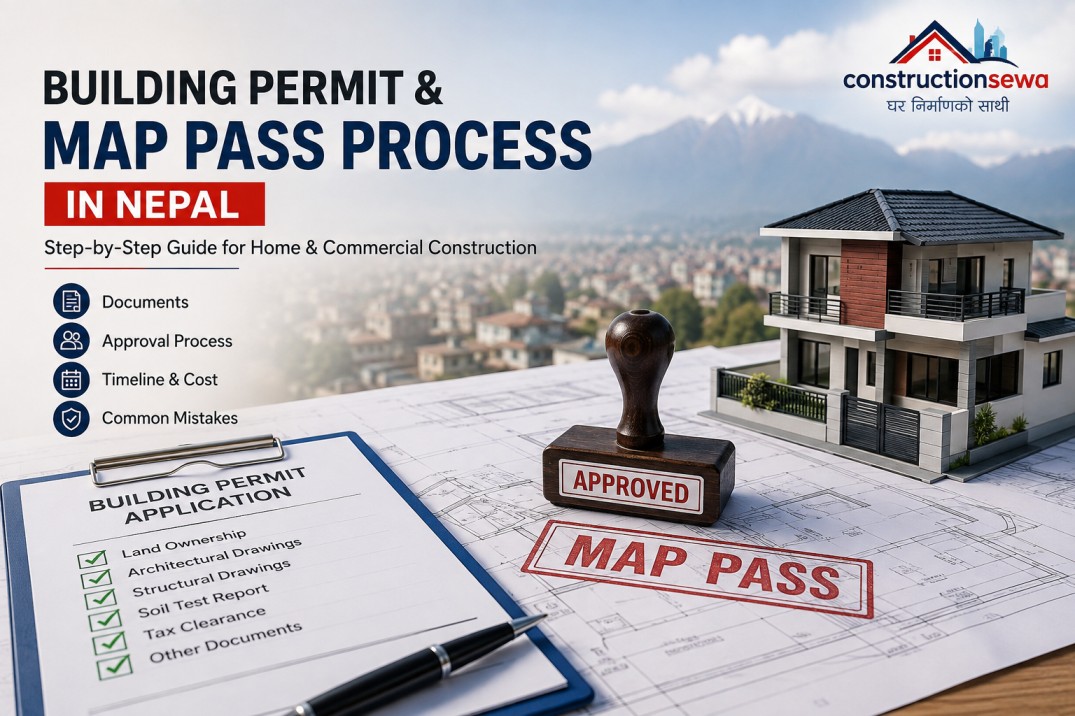
Whether you are going to construct a house or erect a commercial building anywhere in Nepal, there is one step that you cannot miss you need to obtain your Naksha Pass, o
Summarize With AI
Get a quick summary from your favorite AI model
Table of Content
- 1. A Naksha Pass (Building Permit) is what?
- 2. The Map Pass Process and why it is important.
- 3. In Nepal, there are many people who do not require a building permit.
- 4. Documents You'll Need
- 5. The Naksha Pass Process: Step by Step
- 6. Step 1: Pre-Application Consultation
- 7. Step 2: Use a Registered Architect or Engineer
- 8. Step 3: Prepare/Submit Your Application
- 9. Step 4: Public Notice and Ward Review
- 10. Step 5: Municipal Review
- 11. Step 6: The Naksha Pass will be issued
- 12. Step 7: Temporary Permit (Asthai Ijajat Praman Patra)
- 13. Step 8: Foundation Inspection
- 14. Step 9: Permanent Permit (Sthai Ijajat Praman Patra)
- 15. Step 10: On-going Site Inspection
- 16. Step 11: The Completion Certificate (Building Use Certificate)
- 17. The Four Stages of Approval, at a Glance
- 18. How Long Does It Take?
- 19. There are various factors to consider when looking at the costs.
- 20. There are a number of common pitfalls that can hold up the approval cycle, such as:
- 21. Building From Abroad: Power of Attorney
- 22. The report outlines the local considerations across Nepal.
- 23. Key Takeaways
- 24. Frequently Asked Questions
- 25. Looking to get started with your building permit application?
Whether you are going to construct a house or erect a commercial building anywhere in Nepal, there is one step that you cannot miss you need to obtain your Naksha Pass, or the building permit or map pass. It's the official stamp of approval from your local municipality saying that your design is safe, legal and ready to build.
This process is confusing to most people. It's hard to keep track of what documents are needed with land documents, engineering drawings, ward recommendations, and municipal reviews. We've facilitated hundreds of homeowners through this process and we'll take you through it step-by-step in the clearest possible language so you know what to expect.
From constructing your first house in Kathmandu to adding an extra floor to your home in Lalitpur, or even a commercial project in Pokhara or Butwal, this guide has you covered from the documents to the timelines, costs, to the typical pitfalls and what to expect at each construction stage.
A Naksha Pass (Building Permit) is what?
The word Naksha is used for building design or blueprint. Pass: Government reviewed and approved. A Naksha Pass is the official written consent from your municipality/rural municipality that enables you to legally begin work on your land.
If it is not installed, you are not allowed to pour a foundation, build walls, or even install a floor. A building permit verifies that your building design complies with the National Building Code of Nepal, local zoning regulations, road setback standards, and safety standards for structures.
The country's Building Act, 2055 (1998), and the National Building Code of Nepal (NBCN) mandate that Naksha Pass be obtained. It is applicable to any home, apartment building or commercial building, regardless of their location and type, in any rural or urban municipality.
The Map Pass Process and why it is important.
It's not just for the sake of paperwork. The map pass system is beneficial in several practical aspects:
• Earthquake safety: Nepal is in an active seismic zone. The National Building Code provides building code requirements for structures to lower the risk of collapse during earthquakes.
• Legal ownership and resale: A building which doesn't have an approved Naksha Pass is hard to sell, mortgage and insurance.
• Utility connections: Some cities will not let any permanent electric or water lines be connected without a permit.
• Prevention of fines and stop working orders: Fines and stop-work orders can be issued if construction is unauthorized; in extreme instances it can be demolished.
• Setback and boundary compliance: Lessens the chance of neighbour dispute.
In Nepal, there are many people who do not require a building permit.
If you intend to do any of the following, you should obtain a Naksha Pass:
• Building a new residential house, even a small one
• Building a business building, store or office
• Constructing a new storey on top of an old building.
• Adding or removing windows, doors, or walls, especially when removing window panes or doors
• Engaging in the construction of a boundary wall more than a specific height in some municipalities
A new permit will not normally be issued for minor interior repairs or cosmetic work, such as repainting or replacing flooring. If you are not sure, talk to your ward office before you begin - it's a 5 minute conversation that can save you months of hassles!
Documents You'll Need
This is, by far, the number one cause of applications being delayed missing or mismatched paperwork. Before you talk to your municipality, collect these documents:
|
Document |
Why You Need It |
|
Land Ownership Certificate (Lalpurja) |
Certificate that it establishes the legal ownership of the land. |
|
Passport Card |
Identifies the individual applying for the card by name, face, and birth place. |
|
Passport Photo |
Identifies the applicant by name, face and birthplace. |
|
Land Tax Clearance Certificate |
This is to certify that there is no outstanding land tax due. |
|
Architectural & Structural Drawings |
Made by Nepal Engineering Council registered Architect/Engineer and Stamped |
|
Soil Test Report |
Usually required for multi-storey buildings. |
|
Road Clearance / Setback Certificate |
Confirms your design meets road-width / setback requirements |
|
Engineer Approval Certificate |
Signature and stamp of your registered engineer |
|
No Objection Certificate (NOC) |
If you are developing a project that impacts shared boundaries, you will need a No Objection Certificate (NOC) from adjacent landowners. |
|
Power of Attorney (POA) (if applicable) |
must be notarized and if signed outside of the country, embassy-attested |
Others may require more documentation depending on the size, location and purpose of your building. Your architect or local permit consultant will be able to tell you the definitive list for your ward.
The Naksha Pass Process: Step by Step
All the details are a little bit different in different municipalities of Nepal, but it is more or less the same in all places throughout Nepal.
Step 1: Pre-Application Consultation
Do not spend any money on drawings until you check with your municipality's engineering or building department. Talk about land size, building use and a rough plan to build. This is a fast scan that will identify zoning or setback problems before you spend time and money for a redesign.
Step 2: Use a Registered Architect or Engineer
The drawings should be prepared by a professional engineer registered with Nepal Engineering Council. They will share with you the architectural plan, structural plan, electrical and plumbing plans, following the guidelines of the National Building Code and your local municipality's by-laws.
Step 3: Prepare/Submit Your Application
Pick up your documents and submit your completed application to your municipality, either in person or via your municipality's Electronic Building Permit System (EBPS), if available. At this point, you will be charged an up-front application fee.
Step 4: Public Notice and Ward Review
The ward office usually provides a public notice, after the initial review, regarding the proposed construction. This provides the opportunity to the neighbours to raise any concerns, typically due to boundary or setback issues before approval can be considered.
Step 5: Municipal Review
Your drawings are reviewed by the municipal engineers to ensure adherence to the building code, the zoning codes, setbacks, and structural safety codes. They may ask to have a change or re-worded, be prepared to act swiftly and move your file forward.
Step 6: The Naksha Pass will be issued
After the design is approved, the Municipality will provide you with your Naksha Pass. This officially lets you know that your design is approved and details any requirements you need to adhere to during construction.
Step 7: Temporary Permit (Asthai Ijajat Praman Patra)
This allows you to start building as far as plinth level (that is, it is the foundation and the ground floor base). No building is allowed beyond this boundary without obtaining the next stage approval.
Step 8: Foundation Inspection
A municipal inspector inspects your foundation to verify that your foundation meets the approved drawings before you begin constructing upwards.
Step 9: Permanent Permit (Sthai Ijajat Praman Patra)
Once the foundation has been inspected, you receive the permanent construction permit, and you can begin constructing the superstructure (columns, beams, floors, and roofing).
Step 10: On-going Site Inspection
Anticipate inspections at various points: column and beam framework at each floor, electrical rough-in and final structural completion. If your design is not as it appears on the approved drawings, if you want to add an extra floor, a column is out of alignment or you want to encroach on a setback, the change has to be formally submitted for amendment before it can be built.
Step 11: The Completion Certificate (Building Use Certificate)
Apply for Completion Certificate once construction completed. This is not a part of your Naksha Pass and you can't legally register the building for business use, mortgage it fully or transfer the ownership easily without this.
The Four Stages of Approval, at a Glance
|
Stage |
What It Covers |
What You Can Do |
|
1. Naksha Pass |
Drawings sign-off by design |
Nothing yet, this is design review and approval |
|
2. Asthai Ijajat (Temporary Permit) |
Foundation and plinth level construction |
Build up to plinth level only |
|
3. Sthai Ijajat (Permanent Permit) |
Superstructure after foundation inspection |
Continue construction of floors, roof, framework |
|
4. Completion Certificate |
Final inspection when the building is finished |
Legally register, mortgage or sell the building |
How Long Does It Take?
Timelines vary from municipality to municipality, application completeness, and your response time to comments from the review. As a general guide:
• Application review and drawing preparation: 2 - 4 weeks
• Initial application review and public notice period: 2-3 weeks
• Municipal review and Naksha Pass issuance: 3-6 weeks - longer if revision required
• Turnaround for foundation to permanent permit: 1-2 weeks post inspection
For busy urban municipalities such as Kathmandu, Lalitpur and Pokhara, the Electronic Building Permit System (EBPS) has simplified and speeded up the process for tracking application status as compared to the time-consuming paper-based procedure.
There are various factors to consider when looking at the costs.
There are a number of factors that influence the total cost of a permit it is not a one-size-fits-all.
|
Price Factor |
What Influences It |
|
Application & permit fees |
Your municipality may charge these fees which will depend on the type of building and plinth area. |
|
Architect & engineering fees |
will be dependent on design complexity and experience of the firm. |
|
Soil test report |
Required for multi-storey buildings; varies from site access and lab |
|
Structural Drawing Revisions |
Additional rounds of review will incur additional professional costs. |
|
Notarization of a Power of Attorney |
Applies to non-resident owner building through a representative |
|
Consultant/agent fees |
Usually an additional expense, but sometimes included as an option for the owner who wishes to allow the consultant/agent to do the paperwork for them. |
There are a number of common pitfalls that can hold up the approval cycle, such as:
• Providing drawings by an unregistered or unlicensed designer
• Failure to consider setback and road widths for additional space
• This involves beginning foundation work prior to the issuance of the temporary permit.This means that foundation work is commenced without the temporary permit.
• Avoiding a soil test in multi-storey buildings
• Any construction exceeding the approved site plan (elevation), or any floor addition not approved.
• Failure to submit with the land tax clearance certificate
• Rural areas don't need a permit, they do just like urban areas
Building From Abroad: Power of Attorney
A lot of Nepalis abroad have properties here and would like to construct. The process is similar, though with an added step: a Power of Attorney (Rekha Adhikar Patra) is required and must be executed on behalf of the applicant in Nepal for them to pay any fees, attend any inspections, and receive the permit.
Should the Power of Attorney be drafted in a foreign country, it requires to be attested from the Embassy of Nepal in that country as well.When the Power of Attorney is drafted outside Nepal, it needs to be attested by Embassy of Nepal in that country before it can be used by your representative.
The report outlines the local considerations across Nepal.
The National Building Code and the Building Act 2055 apply throughout the country. However, things change day by day depending on the area:
• In the Kathmandu Valley (Kathmandu, Lalitpur, Bhaktapur), density will lead to more stringent checks and EBPS digital submission, and enforcing setbacks will be more stringent.
• Lakeside building guidelines are being applied more in Pokhara and tourism zone guidelines are also being used to a greater extent.
• Butwal and other municipalities in the Terai: Zoning generally provides for greater plinth reas, but the regulations relating to roads remain very strict.
• Rural municipalities: The review process is simpler but the same permit is still required by law.
When preparing your design, always check the requirements for the minimum plot space and the zoning category of your design for your particular ward; this information may vary from ward to ward, even within the same city.
Key Takeaways
• In Nepal, it is legally mandatory to obtain a Naksha Pass before construction, floor addition or any significant change in the structure.
• The process of approval is multi-stage from the Naksha Pass to the temporary permit, followed by a permanent permit, and last the Completion Certificate.
• Drawings need to be created by the architect/engineer registered with the Nepal Engineering Council.
• The most common cause for delays is missing documents, make your paperwork ahead of time.
• If you build without a permit, you could be fined, ordered to stop the work and be required to put it back to normal.
• Non-resident owners are eligible to build via a notarized Power of Attorney
Frequently Asked Questions
1. What is the difference between Naksha Pass and building permit?
Both are the same. In Nepal the official permit to build a home is called the Naksha Pass.
2. How much time does it take for getting a Naksha Pass in Nepal?
Typically takes 6-10 weeks from full application to final approval, depending on municipality and the rate of revisions.
3. Is it possible to begin construction in the meantime of the application process?
NO: Construction before the permit is issued is illegal, even foundation work, must first obtain the temporary permit.
4. Does a Naksha Pass need to be applied for in rural areas also?
Yes. The requirement is applicable to the urban and rural municipalities of the Building Act 2055.
5. If I do not get a permit, what will happen?
You may be fined, a work stoppage may be imposed and a demolition order may be issued in extreme instances. This can also reduce its resale or mortgage value.
6. Let's talk about the building sketches. Who is eligible to draw my building sketches?
Only architects or engineers registered with the Nepal Engineering Council can be allowed. The municipalities will not accept applications from non-registered designers.
7. Do you always need to do a soil test?
For multi-storey buildings it is often required and for any new construction, it is always a good idea to ensure that the soil conditions are taken into consideration when designing your foundation.
8. Which is Asthai Ijajat Praman Patra?
It is a temporary building permit that will enable building up to plinth level or the foundation and base of the ground floor of the building before the permanent permit is issued.
9. Do I have to build if I reside outside Nepal?
Yes. A Power of Attorney is required which must be notarized and issued by somebody in Nepal to act for you with regard to the application, inspections and fees.
Looking to get started with your building permit application?
The process of obtaining a Naksha Pass can be a non-stressful one. We have been able to assist homeowners and commercial clients with all aspects of the project from drawings and documentation, to inspections and final approval in Kathmandu Valley and beyond.
When you are undertaking a new construction, floor addition or commercial project, and you want it done right the first time, give our staff a call for a free consultation. We will analyze your land and guide you through the paperwork you will need and how to avoid the delays most applications encounter.
Community
Likes and comments
Like the post if it helped you, and leave a comment to share your experience. Every comment is reviewed by our admin team before it appears publicly.
Want to join the conversation?
Sign in to leave a comment. Every comment is reviewed by our admin team before it becomes public.
Log in to commentApproved comments
Showing the latest approved conversation for this post.
No approved comments yet
Be the first to start a conversation once your comment is approved.